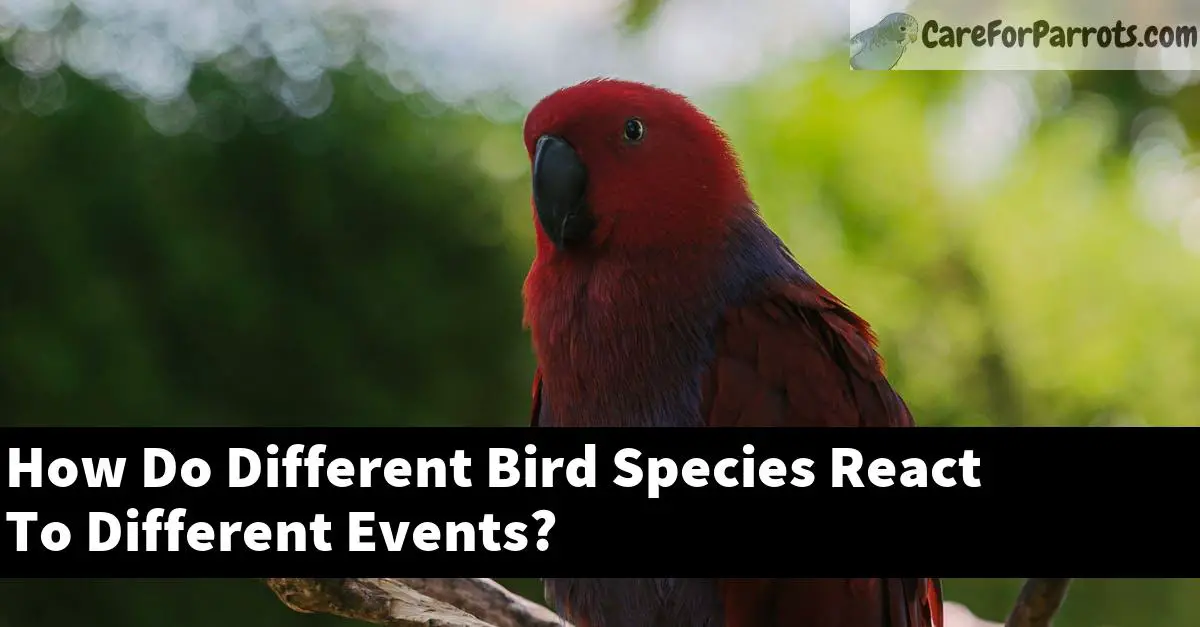
Different bird species react to different events in different ways. Some species, like hummingbirds, are very fast and nimble, and are able to quickly change their behavior in response to a new situation. Other species, like crows, are more deliberate and can plan and strategize their behavior for longer periods of time.
Table of Contents
How do different bird species react to the same event?
Different bird species may react differently to the same event. For example, some bird species may be more vocal than others in response to a scare or noise.
Additionally, some bird species may be more likely to fly away or flee in response to a scare or noise.
How does a parrot react to different events?
A parrot’s reaction to different events can be unpredictable and even humorous. Some common reactions include:
• A parrot may be excited or scared when something new happens.
• A parrot may mimic the sound or movements of people or other animals it is familiar with.
• A parrot may defecate or urinate on occasion.
• A parrot may become aggressive if it feels threatened.
What causes different reactions in different bird species to an event?
There are a few potential reasons why different bird species may react differently to an event. Some of these reasons may be due to the different physiology of the different bird species, such as different levels of stress hormones.
Other reasons may be due to the different evolutionary backgrounds of the different bird species, such as their response to predator threat. Additionally, different bird species may have different social norms and behaviors, which may influence their reactions to an event.
Do all bird species react differently to different events?
In general, bird species react differently to different events. For example, some bird species may be more likely to react aggressively to threats, while others may be more likely to react with flight.


Matiniy 2 Pcs Pirate Parrot on Shoulder Life Sized Artificial Parrot Toy for Costume Dress-up Accessory for Halloween Party(Multicolor)
$14.99 (as of 26/04/2026 10:19 GMT +03:00 - More infoProduct prices and availability are accurate as of the date/time indicated and are subject to change. Any price and availability information displayed on [relevant Amazon Site(s), as applicable] at the time of purchase will apply to the purchase of this product.)


Bird Toys, Parrot Toys for Large Birds,Natural Corn cob and Loofah Slices Bird chew Toys for African Grey Parrots, Macaws, Cockatoos, Amazon Parrot and other Small and Medium-Sized Parrot (Colorful)
$12.97 ($12.97 / count) (as of 26/04/2026 14:36 GMT +03:00 - More infoProduct prices and availability are accurate as of the date/time indicated and are subject to change. Any price and availability information displayed on [relevant Amazon Site(s), as applicable] at the time of purchase will apply to the purchase of this product.)


Kaytee Fiesta Parrot Food, Nutritious and Fun Blend, Supports Skin, Feather, Digestion, Brain and Heart Health, 4.5 pounds
16% OffSome species may also be more likely to react to specific types of threats, such as predators or humans. Each species of bird is unique, and therefore each will react differently to different events.
If two birds witness an event, will they both have the same reaction?
Assuming that the two birds are of the same species and are both able to observe the same event, they will likely have the same reaction. This is because birds are generalists, meaning that they are able to take in a variety of information and react in a similar way.
How do baby birds learn what reaction is appropriate for each event?
The process by which baby birds learn what reactions are appropriate for each event is called “social learning.” Social learning occurs when a bird learns something by observing others who are already knowledgeable about the topic.
Baby birds learn how to behave by watching their parents, other family members, and other birds.
When baby birds are first born, they are very dependent on their parents for survival.
Therefore, parents are usually very attentive to their children and will teach them what to do in most situations. For example, when a baby bird is hungry, its parents will usually feed it.
When baby birds are scared, their parents will usually calm them down.
Baby birds also learn by observing other birds.
When baby birds are young, they are often very curious and will want to know what everyone is doing. So, baby birds will watch other birds and try to figure out what they are doing.
After baby birds observe enough, they will start to imitate what they see.
Does a bird’s reaction to an event change over time?
There is no concrete answer to this question as bird’s reactions to events can vary greatly depending on the individual bird and its individual history. However, there are some general tendencies that can be observed in bird behavior.
For example, most birds tend to react more vigorously to a new event or stimulus over time as they become more familiar with it. Additionally, birds may also exhibit more pronounced or consistent reactions to events depending on their social environment.
For instance, birds that are closely associated with humans or other animals may be more responsive to stimuli in their environment, while birds that live in solitude may be less reactive.
Summary
Some bird species are fast and nimble, while other species are more deliberate and can plan their behavior for longer periods of time.